Keep the waist reference and article condition beside the value
A boxer-waist dimension enquiry should identify the offered garment and ask the supplier which marked points, article condition and unit apply to any returned value. A number without that context is not a complete measurement reference. Do not infer a waist dimension, stretch range or fit from the catalogue photograph. Record an unanswered condition explicitly rather than treating every supplier value as directly comparable.
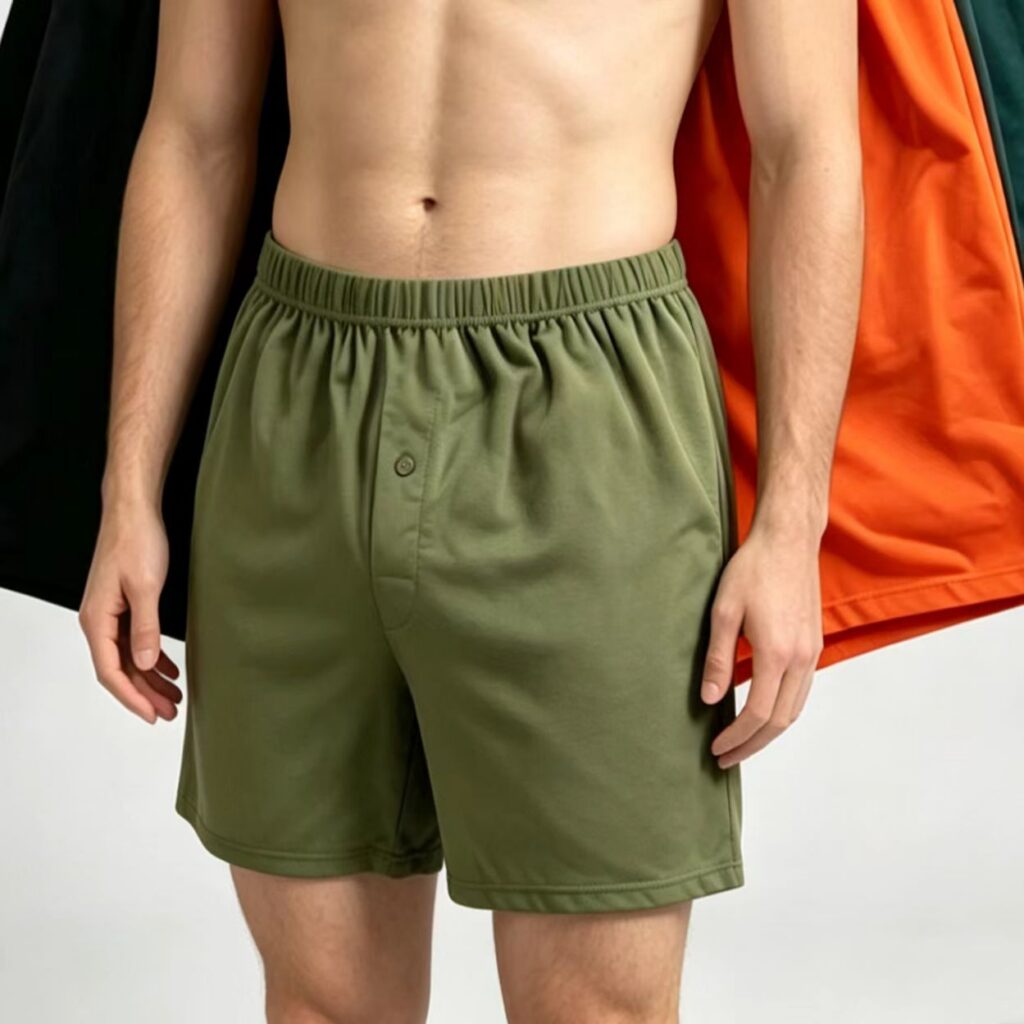
The official listing includes loose-boxer-style catalogue references. The separate plain-garment front on-body photograph used here is an appearance reference; it does not identify the offered version, size or material. That image identifies the catalogue enquiry without independently establishing garment category, fabric composition or fit. The page’s fabric alternatives also leave composition to be confirmed. This guide concerns the scope and condition of a waist measurement. Clarifying the garment’s category remains a separate purchasing question and should not be resolved by an assumed measurement convention.
Begin with the exact article being discussed
Send the product link and the supplier’s quotation or article-version reference. Ask which garment the response covers and how the supplier identifies its waist reference. Preserve the actual terms returned instead of replacing them with a familiar buyer convention. If the supplier gives a value but no article relationship, retain the value as an attributed response while recording the missing relationship as an open question.
The photograph should not become a substitute measurement record. An on-body view does not independently establish a garment dimension or a wearer’s body circumference. Nor does it identify the condition used for a supplier’s measurement. Ask for a marked reference or an attributable description of the points and context where needed. Do not estimate dimensions from the image or copy a value from another catalogue garment that appears similar.
Create a measurement-condition record
Record field | Information to request | Boundary to preserve
Offered article | Exact garment or quotation version | Other catalogue garments or variants
Waist reference | Supplier-marked points or description | A buyer-estimated boundary from the image
Article condition | Actual context stated for the measurement | An assumed stretch or testing method
Returned value and unit | Supplier’s attributed response | An independently verified fit or size range
Open question | Missing point, condition or relationship | A fabricated complete measurement specification
This record allows partial information to remain useful. A supplier may identify the measurement reference before providing a value, or provide a value whose condition is still unclear. Keep the answered scope and ask the specific remaining question. Do not make the table look complete by assuming that a descriptive term always means the same thing across suppliers or that every version of an article has an identical reference.
Keep stated conditions distinct without inventing a test
If the supplier identifies different article conditions, retain each response separately with its own wording. Ask how the values relate to the actual offer. Do not prescribe a stretching force, testing procedure, maximum extension or other method that has not been established by the source. The purchasing question is what the supplier’s response means, rather than how the buyer should create an unverified test or derive a performance range.
Likewise, do not turn a difference between two values into an elasticity or compression claim. It might reflect different reference points, article versions or other unconfirmed context. Record the discrepancy and request clarification without inventing the reason. A clear dimension enquiry preserves the distinction between an attributed measurement response and evidence of stretch performance, recovery, comfort, body fit or product suitability.
Compare responses only after aligning the scope
When comparing quotations, check whether the values describe the same article reference, points and stated condition. If the scopes differ, keep that difference visible before comparing numbers. One response may be more precisely identified without establishing that the garment is better or that another response is wrong. An attributable explanation is more useful than a numerical comparison that silently combines measurements taken under different, undefined contexts.
Keep fabric descriptions and supply terms separate. Catalogue references to fabric alternatives or a visible waistband do not independently establish fibre percentages, construction methods, tolerances or performance. A dimension response also does not establish available sizes, mix-size supply, customization, stock, minimum quantities, price or delivery terms. Ask about those matters separately and retain the supplier’s actual scope rather than extending a waist-reference answer into a complete offer.
Retain revisions and unresolved category questions
If another measurement reference or value is proposed, keep the earlier response and identify the article or quotation version affected. Ask whether the new answer changes the points, condition or offered version. Do not silently replace a value from memory or assume why it differs. A revised number can answer a narrow question without updating every specification or commercial detail associated with the garment.
The category clarification remains separate throughout. A product name or waist value does not establish how the buyer should classify or use the garment. Before carrying the measurement record into an order discussion, review the actual points, condition, unit and article relationship. Keep unanswered fields visible. This guide provides no fitting, use, care or testing directions and makes no claim about suitability, comfort, health or safety.
Frequently asked questions
Can waist size be estimated from the on-body catalogue image?
No. The image identifies a product reference, not an independently established measurement scale. Request the supplier’s actual value with its marked points and stated article condition.
Does a returned value establish stretch performance or fit?
No. A measurement response has a specific attributed scope. It does not independently verify elasticity, compression, recovery, comfort or a range of body sizes that the garment will fit.
How should two different measurement conditions be recorded?
Keep each response with its actual wording and ask how it relates to the offer. Do not invent a stretch force, test method or explanation for a difference that the supplier has not established.
Does a waist-reference answer resolve the garment category?
Not automatically. Category and measurement condition answer different procurement questions. Preserve each response within its actual scope and retain any missing relationship explicitly.
Use the official loose-boxer-style reference to anchor the measurement enquiry and contact the supplier with the exact unanswered fields. Catalogue imagery and descriptions remain attributed context rather than verified dimensions, fabric properties, fit or supply commitments.
https://xlingmenswear.com/product/men-s-loose-boxer-briefs/
https://xlingmenswear.com/contact/
https://xlingmenswear.com/blog/