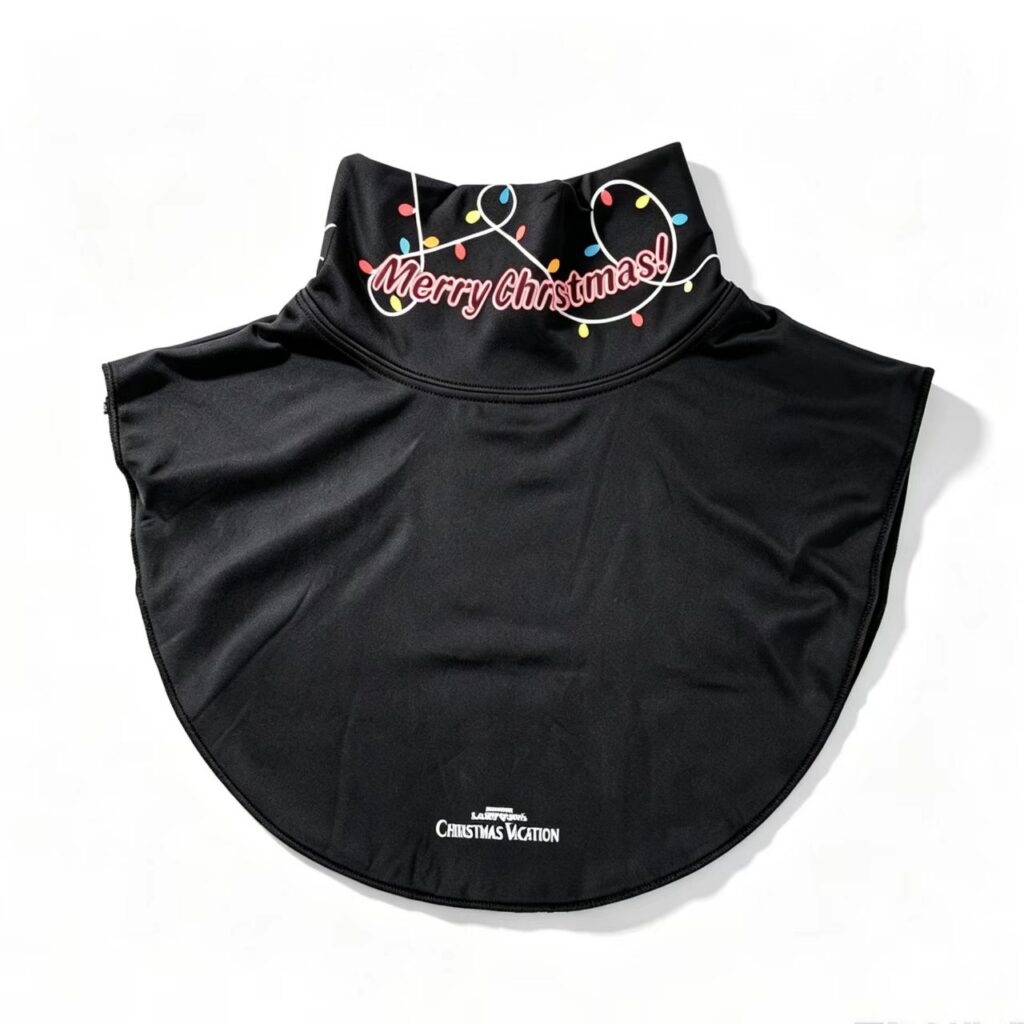
For a printed turtleneck dickey RFQ, ask the supplier to identify the front and back panels and mark the exact edges used for each requested measurement. Xiangling Menswear’s reference describes a pullover turtleneck with curved shoulder panels. A flat-lay photograph helps locate that accessory, but does not establish dimensions, stretch behaviour or fit. Specify the measurement object, endpoints and presentation condition before requesting values, so a neck dimension and a shoulder-panel dimension cannot be mistaken for the same reference.
Identify the accessory and its viewing direction
Attach the exact printed-turtleneck-dickey product link and ask the supplier to identify the front and back of the offered version. The source description refers to curved front and back shoulder panels. Keep both views named in the enquiry instead of assuming that the one photographed side defines every edge of the complete accessory.
Ask the supplier to mark the relevant panel on a suitable product reference. A lettered front and back view can make the requested measurement easier to identify without assigning values. If an edge is concealed or folded in the catalogue image, request a clear supplier reference for that edge rather than reconstructing its outline from the visible portion.
Separate neck measurements from shoulder-panel measurements
Name the physical part being measured before requesting a dimension. For a neck-related question, ask the supplier to show the precise opening, seam or edge used as the reference. For a panel question, identify the panel and its boundary. These are different measurement objects even when they appear together in the same flat-lay view.
Do not label a single unspecified value as the overall size of the dickey. Ask which reference the value describes and whether the supplier’s method matches the buyer’s question. A dimension at the neck cannot silently substitute for the reach of a shoulder panel, and a panel width does not by itself describe the complete opening around the neck.
Requested reference | What the supplier should identify | Keep with the returned value
Front panel | Which view and curved lower edge belong to the front? | Named view and marked endpoints
Back panel | Which view and lower edge belong to the back? | Separate view and measurement reference
Neck area | Which opening, seam or edge is being measured? | Named physical reference and method
Shoulder span | Which side edges define the requested span? | Both endpoints and presentation condition
Curved lower edge | Is the value a straight span or an edge-following measurement? | Explicit method and unit
Mark endpoints on the actual product outline
For each dimension, request a marked start and finish on the supplier’s reference. Where the lower edge is curved, clarify whether the question concerns a straight distance between named points or a measurement following the edge. Do not treat those methods as interchangeable or infer one from the shape of the photograph.
Keep the unit and measurement direction attached to the marked points. If the buyer needs a reference from the neck seam to a lower edge, ask the supplier to identify those boundaries explicitly. Avoid inventing a midpoint or using a decorative print as a substitute datum unless the supplier has specifically defined it for that measurement request.
State the presentation condition without guessing stretch
Ask the supplier to state how the accessory is presented when measurements are taken. The source describes a stretch knit, with composition to be determined, but that wording does not establish a quantified extension, recovery result or a specific measurement condition. Request the condition relevant to the buyer’s dimensional question rather than assigning a stretch allowance.
If different measurement conditions are required, identify them as separate requests with separate supplier methods and values. Do not derive an extended dimension from an unextended one, or claim that an opening will accommodate a particular wearer based on its appearance. The supplier’s measurement response should remain distinct from any separately required fit assessment.
• Identify front and back before naming panel dimensions.
• Mark both endpoints for each requested measurement.
• Distinguish a straight span from a path following a curved edge.
• Keep presentation condition, measurement method and unit together.
Keep decoration and construction questions separate
The source describes prints at the neck and hem along with bound or overlocked edges. Use those descriptions to locate questions about the pictured accessory, while asking the supplier to confirm the construction of the offered version. A visible print position does not establish the dimensional location of an underlying seam or panel edge.
If the buyer proposes different decoration, request a separate supplier confirmation for the artwork and its intended placement. Do not let a change in print reference redefine the measurement endpoints without explanation. Likewise, neither the image nor the construction description establishes print durability, fibre composition or permission to reproduce the pictured artwork for another order.
Send a marked-edge measurement request
An enquiry can read: Please identify the front and back of the linked printed turtleneck dickey. Mark the neck reference, both shoulder-panel side edges and the relevant curved lower edges. For each requested dimension, show the start and finish, method, unit and presentation condition. Please distinguish straight spans from measurements taken along an edge.
Retain the supplier’s marked reference beside its returned values and quotation identity. If the panel outline changes, request an updated measurement reference for the revised proposal. This gives the buyer a clear dimensional question without estimating values from a photograph or promising an unverified fit, material composition, thermal result or stretch performance.
Frequently asked questions
Can a single flat-lay image establish the front and back dimensions?
Ask the supplier to identify both panels and provide the relevant marked views before requesting values.
Is a curved-edge length the same as a straight span?
State which method is required and keep the supplier’s method attached to the returned value.
Does stretch knit wording establish an extension allowance?
No quantified stretch behaviour is confirmed by that description. Request any required method and evidence separately.
Do the marked measurements guarantee fit?
Keep any required fit assessment separate from the dimensional reference and the supplier’s measurement response.
Product and contact references
Product reference: https://xlingmenswear.com/product/printed-turtleneck-dickey/
Related apparel and accessories: https://xlingmenswear.com/products/
Contact Xiangling Menswear: https://xlingmenswear.com/contact/
Xiangling Menswear blog: https://xlingmenswear.com/blog/